

“Key” Facts
About Kappa Kappa Gamma
“Kappa Kappa Gamma is an organization of women, which seeks for every member throughout her life bonds of friendship, mutual support, opportunities for self-growth, respect for intellectual development, and an understanding of, and an allegiance to, positive ethical principles” (Mission Statement, Kappa Kappa Gamma Fraternity Council, 1984-86).
History: Kappa Kappa Gamma, one of the oldest sororities in North America, was founded in1870 at Monmouth College, Monmouth, Illinois, by six young women focused on the promotion of academics and leadership. Today there are more than 140 chapters throughout the United States and Canada, with more than 260,000 members.
Colors: Dark Blue & Light Blue
Pin: Golden Key
Flower: Fleur-de-lis (Iris)
Jewel: Sapphire
Official Symbol: Owl
Roman Patron: Minerva
About Our Beta Xi Chapter
Pronunciation: Beta “Ka-zee.” While not true to the correct pronunciation of the Greek letter “Xi,” this pronunciation was established early in our history and remains part of our chapter tradition.
Founding: Beta Xi was founded on The University of Texas at Austin campus in 1902 with 15 charter members.
Membership: Throughout its long history, Beta Xi has initiated more than 4,700 members. While most have been from Texas, Beta Xi members also come from many parts of the United States and other countries. In recent years, the Beta Xi Chapter has maintained an average active membership of 250-280 young women.
Goals: Philanthropy, Scholarship, Leadership, and Camaraderie.
Beta Xi is a welcoming community in which our members forge life-long friendships and gain valuable skills that serve them well in their lives beyond graduation.
About Our Historic Chapter House
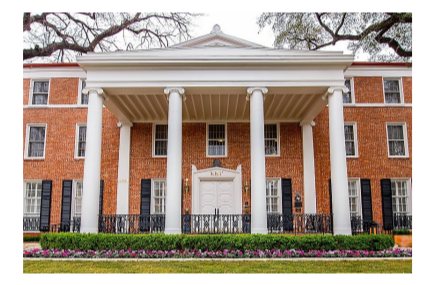
Fondly referred to as the “Grande Dame of University Avenue,” our chapter house has been awarded three historic designations: city, state, and national. It has been described as “a house full of history and beauty...a fine example of blended Revival architecture...and an important part of Austin’s past and present.”
The Early Years: The original Beta Xi chapter house resided on the northwest corner of 24th and Rio Grande. As the membership grew, the chapter requested a larger house closer to campus. On August 24, 1936, the Beta Xi alumnae group formed the House Association of Beta Xi Chapter of Kappa Kappa Gamma whose mission was to turn this request into a reality.
Lot: In 1936, the House Association purchased the lot on the northeast corner of 20th Street and University Avenue and began planning the construction of the new chapter house.
Architect: In 1938, the House Association hired noted Houston architect Birdsall P. Briscoe to design the chapter house. Among the many famous Houston homes in his portfolio, the most notable is “Bayou Bend,” constructed in 1928 for Ima Hogg, the daughter of Texas Governor James Hogg. Working with Briscoe, the House Association chose a blend of Greek and Georgian Revival styles for the new chapter house.
Completion: On completion in 1939, the house had three floors and a basement and housed 38 young women.
Featured in Architectural Digest: In 1943, Architectural Digest published a feature story on Birdsall Briscoe and included four photos of the recently completed Beta Xi Chapter House.
1972 Addition: In 1972, the House Association expanded the house to include a large garden room just beyond the dining area. The garden room was the last significant addition to the house until 2016.
2016 Renovation: We are extremely grateful to the more than 1,200 Beta Xi alumnae, families, and friends who generously donated to the recent renovation and expansion of this beautiful old home. All historic portions of the exterior and interior were preserved and refurbished with care, while 6,000 square feet were added to the back of the house. This expansion allowed more than one third of the house to be dedicated study space and made it possible to accommodate 29 bedrooms. Among the other important improvements were additional, enlarged bathrooms; second- and third-floor lounge areas; an all-new commercial kitchen; a new hardwood back stairway; an elevator; a redesigned, expanded basement; updated plumbing and electrical wiring; and state-of the-art audiovisual, internet, and security systems. The house has been redecorated top to bottom and is now equipped to comfortably house up to 65 young women and serve an average of 175 meals daily.